Who a dishwasher suits — and the one decision that matters most
For most households the question isn't whether to buy a dishwasher but which one, and the honest answer starts with your kitchen rather than the brochure. A machine that cleans brilliantly is useless if it won't fit your gap or hold a day's washing-up, so before you fall for a feature list, settle two things: the size (full-size 60 cm or slimline 45 cm) and the capacity (how many place settings you need). Get those right and almost any decent machine on this list will serve you well; get them wrong and even the best dishwasher in the world will frustrate you. Our size guide walks through the maths so you buy once and buy well.
It's worth being clear about the trade-offs, too. A dishwasher uses less water than washing the same load by hand and frees up real time, but it isn't free to run, and the cheapest machines cut corners on drying and noise rather than on cleaning. The good news is that the gap between a £300 machine and a £900 one is far smaller on the actual wash than the price suggests — what you mostly pay extra for is quieter running, better drying, more flexible baskets and a longer life. Decide how much those things matter to you, and the rest of the choice falls into place.
Full-size or slimline: matching the machine to your kitchen
The single most common buying mistake is choosing the wrong width. A full-size dishwasher is 60 cm wide and holds 13 to 15 place settings — the right answer for any family and the best value per place setting. A slimline machine is 45 cm wide and holds around 9 to 10 settings, which is plenty for a couple and a lifesaver in a galley kitchen or a flat where a 60 cm machine simply won't fit. Don't size down to save money if you have the space, because a slimline machine costs more per place setting and means running more cycles; only choose slimline when the gap genuinely demands it, as with our Bosch Serie 2 slimline pick.
Whatever the width, measure the height and depth of your gap as well, and leave room for the door to drop open and for the water and waste connections at the back. If your kitchen is a fitted run of matching cupboards, you may also be weighing up a built-in machine hidden behind a furniture door — a question we cover in full in our guide to integrated vs freestanding dishwashers. For renters and most buyers, though, a freestanding machine is the easier, cheaper choice, and every model on this ranking is freestanding for exactly that reason.
How to read place settings and capacity
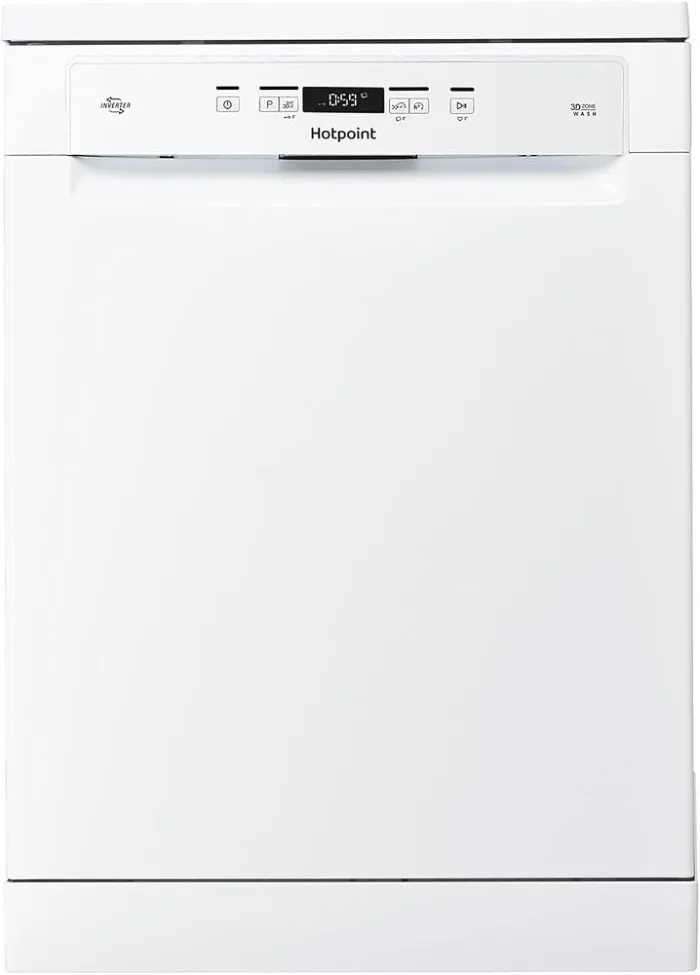
A "place setting" is a standardised set of crockery and cutlery for one person — a dinner plate, side plate, bowl, cup, saucer, glass and the usual cutlery. Manufacturers quote capacity in place settings so you can compare machines fairly, but real life doesn't load that neatly: pans, mixing bowls, baking trays and oversized platters eat into the quoted figure fast. As a practical rule, count one place setting per person you regularly cook for, then add a couple of settings of headroom for the awkward items. A family of four is comfortable with a 13-setting full-size machine; a busy household that cooks from scratch will appreciate the 15 settings of our family pick, the Hotpoint HF5C2615WG. Flexible, fold-down racks matter more than the headline number, because they're what let you fit those big items in at all.
Noise: what 44 to 50 dB really means
Modern dishwashers are far quieter than they used to be, but there's still a meaningful spread. Around 44 to 46 dB is genuinely quiet — fine to run overnight or in an open-plan kitchen-diner without anyone noticing, which is exactly why the Miele G 5310 SC (44 dB) and Bosch Series 4 (46 dB) are so easy to live with. Around 47 to 50 dB is still perfectly acceptable but more noticeable, especially if your kitchen opens onto a living or sleeping space. Because decibels are logarithmic, even a 3 dB drop is a real reduction in perceived noise, so if quiet matters to you it's worth paying for. We rank the options in our guide to the quietest dishwashers.
Energy ratings and the truth about running cost
Since the energy label was made stricter, very few dishwashers reach the top A or B grades, and most good machines now sit between C and F. Don't fixate on the letter alone: the spread of running cost between neighbouring grades is modest, and the bigger lever is how you use the machine. The single cheapest habit is to run the eco programme — it uses less water and heats it more gently over a longer cycle, which sounds counterintuitive but genuinely costs less to run than a fast wash. Running a full load rather than a half-empty one, and using a delay-start timer to run overnight on a cheaper electricity tariff, save more in practice than chasing the very best energy grade. Our buying guide covers running cost, programmes and the features actually worth paying for in full.
How we chose these six
We deliberately picked machines that cover the full range of real UK kitchens rather than six near-identical full-size boxes. There's a clear best overall, a value champion, the keenest budget machine, a no-compromise premium option, a slimline specialist for tight kitchens and a big-capacity choice for families. Every model here is from a brand that's genuinely available and supported in the UK, and each one earns its spot for a specific buyer — there is no padding. If you start by working out your kitchen's size and your capacity needs, you'll find your machine on this list. To see exactly how we score them, read our how we test page.